What Do We Notice When We Look at Nature?
Series: The Experience of Natural Imagery
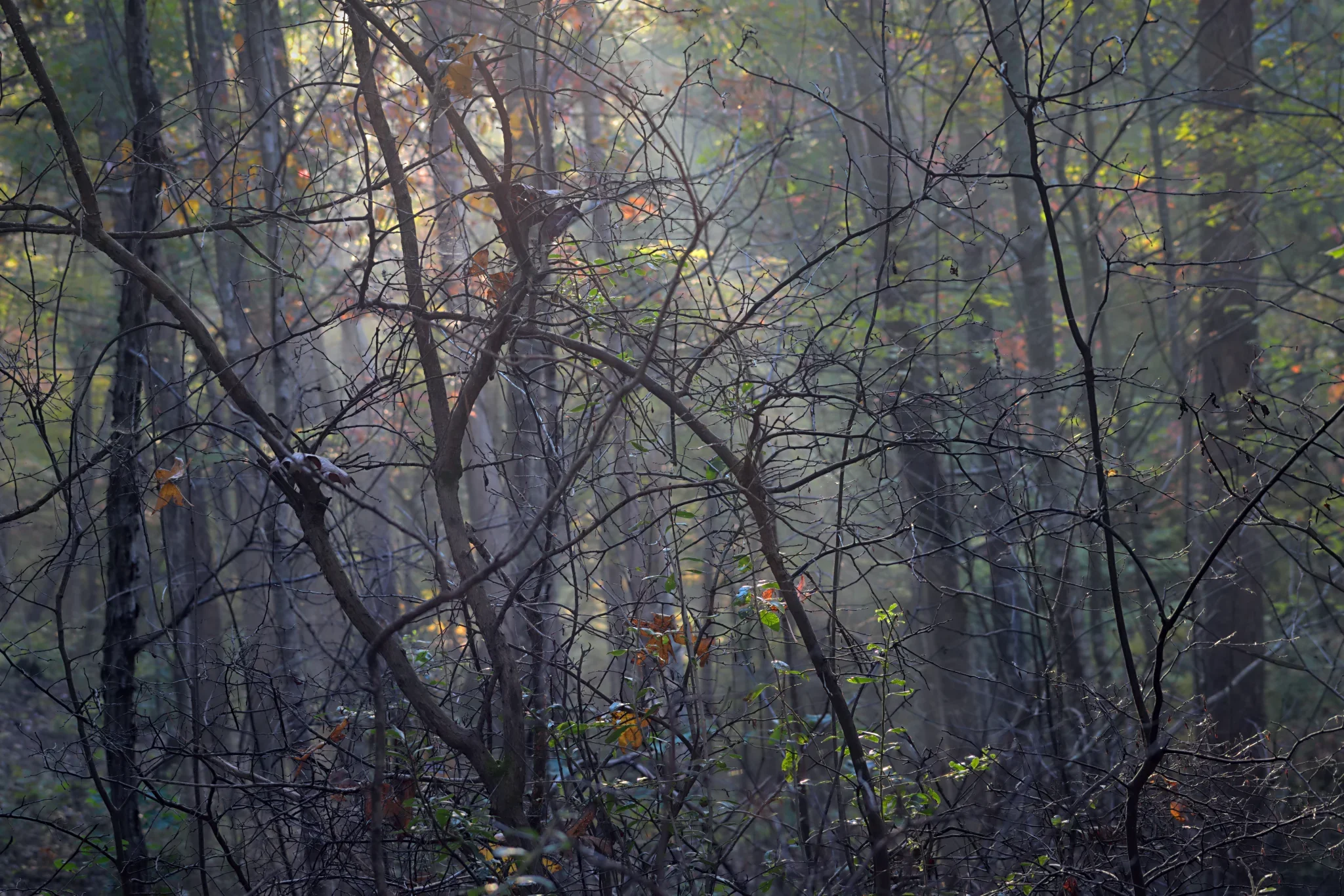
A woodland can seem familiar at first glance. Trees, leaves, branches, stones, water, shadows.
What is less clear to me is what I actually notice when I stand there.
I don’t take in every part of a scene with equal attention. My focus usually settles somewhere. A pale trunk might stand out against darker trees. A branch might bend across a field of vertical lines. A small patch of green might hold my attention longer.
Another person might see the scene entirely differently.
That difference interests me because it suggests that looking is never only about what is present. It also seems to be about what catches, interrupts, repeats, or feels familiar enough to hold us for a moment.
Where Attention Begins
In some landscapes, what draws my attention may be easy to identify. A horizon divides the scene. A mountain rises above the land around it. A bright area of water pulls the eye outward.
Inside a forest, focus can feel less settled.
Trunks overlap. Branches cross one another. Near and distant forms may share similar tones. Openings appear and disappear between trees. No single part of the scene announces itself as the subject right away.
Still, something usually comes forward.
It might be contrast. It might be a change in direction. It might be one repeated form that differs slightly from the others. Sometimes it is simply the thing that looks unusual enough to interrupt the overall pattern.
The first point of attention does not always remain the most important part of the scene. It may only be the place where the realization begins.
Objects and the Space Between Them
We tend to describe natural scenes by naming what is there.
A tree. A creek. Moss. Stone. Fallen leaves.
Those names are useful, but they don’t fully describe what holds my attention. Often it is not the object alone, but its relationship to what surrounds it.
A branch curves around a trunk. Two trees stand close enough to create a narrow opening. A dark patch of bark repeats farther back in the woods.
The longer I look, the less separate these things begin to seem.
The tree is still a tree, but its position matters. The branch is still a branch, but so does the direction in which it moves. The spaces between forms begin to carry as much visual weight as the forms themselves.
When I frame a photograph, I am placing a boundary around those relationships. It does not remove the complexity of the forest, but it selects which parts of that complexity will remain together and available to the viewer.
The Speed of Recognition
Recognition can happen quickly.
A scene becomes “forest” before many of its smaller differences have been noticed. A surface becomes “moss-covered stone.” A group of trees becomes “trees beside water.”
That first recognition is useful to me. It gives the scene a name and a general order I can start to process.
It can also bring looking to an early stop.
Once the subject has been identified, there is a temptation to feel that the scene has already been understood. Yet the broad category says very little about this particular arrangement of trunks, textures, openings, and tones.
With more time, the category sometimes recedes and the differences begin to matter more.
A branch that first seemed incidental might start to organize the image. A quiet area near the edge might begin to balance a heavier form elsewhere. A repeated tone might create a connection between foreground and background.
Nothing new has appeared. My point of focus has simply shifted.
What the Viewer Brings
The same woodland might not present itself in the same way to everyone.
A dense interior might feel familiar to one person and closed in to another. A certain color might recall a season or place. A narrow creek might resemble somewhere remembered, even when the photograph was made far away.
Some responses might be tied to clear memories while others might be harder to explain.
Preference also guides what we notice. One person might be drawn to open space and separation. Another might prefer accumulation, irregularity, or layered detail. Someone familiar with plants might notice distinctions that another viewer passes over. A photographer might pay attention to the way forms are arranged. Someone else might simply be held by an unusual shape.
The scene doesn’t change, but the point of entry does.
Looking Outdoors and Looking at a Photograph
Outdoors, looking is mixed with everything else.
The body is moving. Light changes. Wind shifts leaves and branches. Sound comes from outside the field of view. Awareness moves between what is seen and what is happening around it.
A photograph removes much of that.
The image stays still. The frame remains fixed. The light doesn’t change. The viewer can return to the same arrangement without returning to the place.
That stillness might make some relationships easier to notice. It also removes much of what belonged to the original experience.
Because of that, looking at a photograph can become a more concentrated experience. Certain forms remain near one another and nothing moves out of view.
What was one moment outdoors becomes something that can be revisited.
After the First Look
Once the first recognition has passed, an image may either open further or begin to close.
Some images present themselves quickly. The main subject is clear. The composition is easy to follow. The surrounding details support the first impression.
Other images take longer to resolve.
At first, they might appear dense, quiet, or difficult to organize. Then one relationship becomes visible. A line in the foreground begins to connect with a form farther back. A repeated shape creates a pattern. A small contrast starts to matter.
The first look might be mostly about recognition.
Later looks might be more about structure.
That doesn’t mean every complex image becomes more interesting with time. Some remain unresolved. Some lose our attention. Some continue to reveal small relationships that were present from the beginning but not immediately noticed.
Maybe that is part of what we are doing when we look at nature, whether outdoors or in a photograph.
We are not seeing everything at once. We are noticing one thing, then another, gradually becoming aware of the relationships that hold the scene together and of how much remains outside our attention.
Click here for the specific print details of the art shown in this writing.
